Life Below Stairs: Daily Routines, Rules, and the Servants’ Door
The Edwardian country house was a world divided. While family and guests enjoyed glittering drawing rooms, grand dining halls, and manicured gardens, a parallel life existed behind the scenes. Servants had their own spaces, their own rules, and even their own entrances. Watching Downton Abbey makes this separation strikingly clear — and it reflected the reality of early 20th-century Britain.
To understand how this world was structured, read Life Below Stairs: The Servant Hierarchy in the Edwardian Era.
The Servants’ Door and Hidden Entrances

Every great house had a separate entrance for servants. Often tucked discreetly at the back or side of the building, this door was plain and practical, leading directly to the kitchens, pantries, or servants’ corridors. It symbolized the invisible labor that sustained aristocratic life: the family and guests used the ornate front door, while staff entered quietly through their own.
Once inside, servants navigated a network of back stairs and hidden passageways. These routes allowed them to move from kitchens to bedrooms, dining halls, and parlors without being seen, maintaining the illusion of effortless luxury for the family upstairs. To use the front staircase or main corridors was unthinkable unless explicitly required.
For a closer look at the unseen workers who passed daily through these corridors, see The Junior Roles in Edwardian Households: Scullery Maids, Hall Boys, and Other Assistants.
The Daily Hierarchy in Practice

The structure below stairs mirrored the formality above. Orders flowed downward like a chain of command:
- The family gave instructions to the butler and housekeeper.
- These senior staff assigned tasks to valets, maids, footmen, and cooks.
- Junior servants carried out the hardest and least visible work.
Even mealtimes reflected hierarchy. In the servants’ hall, the butler and housekeeper sat at the head of the table, while junior servants served them before eating themselves. Just as the family dined in elegance upstairs, rank determined one’s place and treatment downstairs.
Rules of Conduct and Etiquette
Life below stairs was governed by strict codes of behavior:
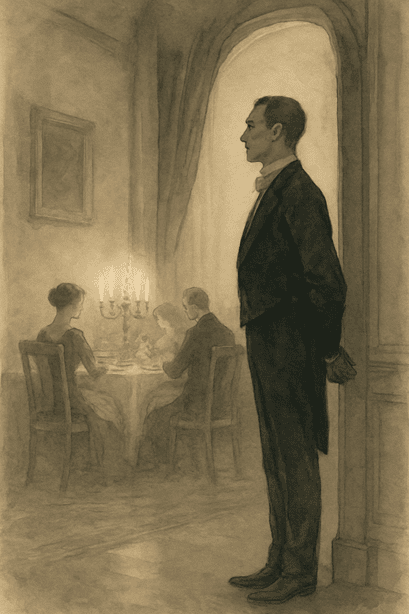
- Servants moved quietly and efficiently, expected to be almost invisible unless required.
- The family was addressed formally: “Sir,” “My Lady,” “Mr.” or “Mrs.” — never by first names.
- Eye contact and conversation were limited to what was necessary.
- Senior servants enforced discipline, and serious breaches could mean instant dismissal.
This etiquette reinforced both distance and respect, shaping how servants interacted not only with the family but also with each other.
The delicate relationships formed in these private spaces are vividly shown in Valets, Lady’s Maids, and Personal Attendants in Edwardian Households.
Daily Routines Below Stairs

The workday for servants was punishingly long:
- Early morning: The hall boy and scullery maids rose first, often before 5 a.m., to light fires, haul water, and begin cleaning.
- Morning duties: Housemaids hurried to clean bedrooms and chambers before the family awoke, while kitchen staff began preparing breakfast.
- Daytime: The butler, footmen, and parlour maids managed meals and guests, while laundry maids, kitchen helpers, and gardeners worked continuously behind the scenes.
- Evening: Servants prepared bedrooms, served dinner, and polished silver or shoes for the next day. Work rarely ended before late at night.
The rhythm of service left little room for personal freedom. Days blurred into one another, bound by bells, orders, and duties.
The Physical and Social Separation
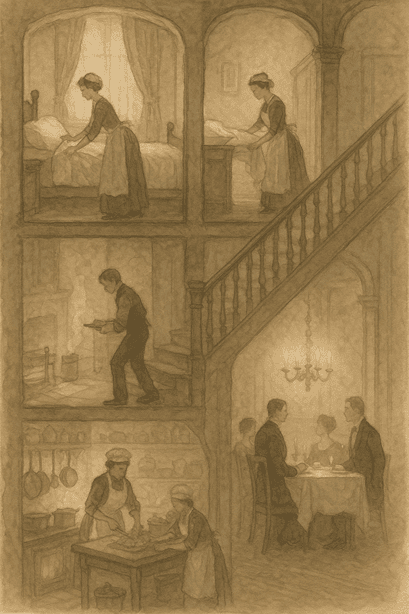
Architecture itself reinforced the divide between family and servants. While the main rooms of the house dazzled with chandeliers, gilded furniture, and rich fabrics, the servants’ quarters were plain, functional, and cramped. Bedrooms were often shared, tucked into attics or basements.
The servants’ hall was the one communal space where the staff could gather, eat, and briefly relax — though even there, hierarchy was enforced. The design of the house reminded servants daily that they were there not for comfort or leisure, but to serve.
Final Thoughts
The servants’ door, the hidden staircases, the rules of conduct, and the rigid routines all remind us that Edwardian service was more than just work — it was an entire way of life, structured by separation and discipline. Behind the elegance of the front door lay a world of quiet, unseen effort. The servants’ daily hierarchy ensured that the great country houses of the era ran smoothly, though always at the cost of those who remained in the shadows.
Life Below Stairs Series
- Life Below Stairs: The Servant Hierarchy in the Edwardian Era
- Life Below Stairs: Daily Routines, Rules, and the Servants’ Door
- The Senior Staff: Butlers, Housekeepers, and Cooks
- Valets, Lady’s Maids, and Personal Attendants
- The Working Staff: Footmen, Maids, and Chauffeurs
- The Junior Roles: Scullery Maids, Hall Boys, and Other Assistants
- The Decline of the Servant Era
- Life Below Stairs: The Servant Hierarchy in Downton Abbey