Children of the Medieval Castle: How Young Lords and Ladies Were Raised
Within the stone walls of medieval castles, children were not idle. Though born into privilege, young lords and ladies were prepared from an early age for the heavy responsibilities, duties, and expectations that came with their lineage. Their childhoods were shaped not only by play but also by careful education, religious devotion, and training for the roles they were destined to fill. While peasant children worked in fields and villages, the sons and daughters of nobility grew up in a highly structured environment where every detail of their upbringing was designed to reinforce the ideals of their class.
Early Childhood: The First Years of a Noble Child
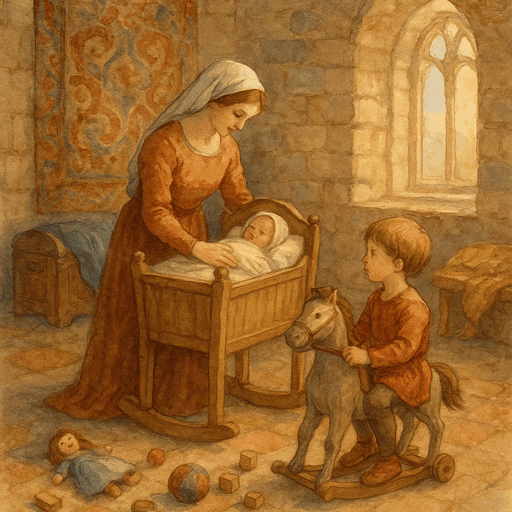
Life for a noble child began with both privilege and ceremony. Births were occasions for celebration, as dynastic survival depended on producing heirs. Midwives attended mothers in their chambers, while prayers and blessings were offered for safe delivery.
- Infancy: Babies were swaddled tightly in cloths to keep them straight and strong, following beliefs about proper development. Wet nurses were often employed, especially for noble children, freeing the mother for other duties.
- Godparents: Baptism happened quickly after birth, sometimes within days, due to high infant mortality. Godparents were carefully chosen as political and spiritual allies.
- Early care: Children under seven were considered too young for structured education. Their days were filled with play, learning basic manners, and absorbing the rhythms of castle life. Nurses, servants, and tutors hovered constantly.
Even in infancy, noble children were raised to embody their family’s status, dressed in fine miniature clothing that reflected their rank.
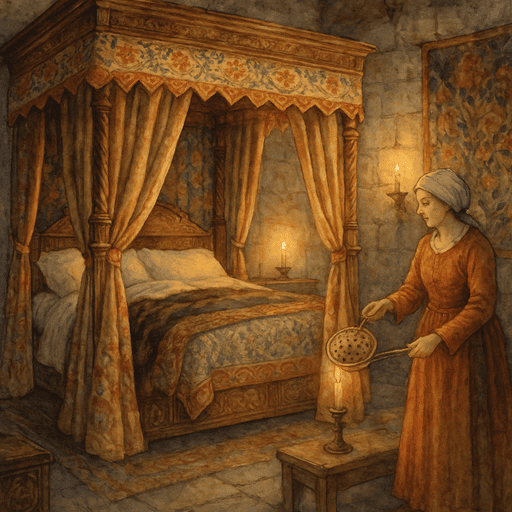
From birth, noble children were surrounded by attendants. Infants were often raised not solely by their mothers but by a team of nurses, wet nurses, and rockers. This early care focused on ensuring survival in an age when infant mortality was high, and noble families could not afford to lose an heir. As toddlers, they moved into a nursery or solar space under the supervision of governesses and nurses, where they began to learn proper manners and basic prayers.
- Nannies and nurses: Provided physical care, ensured feeding, and oversaw the earliest stages of learning.
- Governesses: Introduced children to proper behavior, obedience, and the expectations of noble society.
Here, the seeds of discipline and status awareness were sown, as children were gently reminded of their privileged position compared to the servants around them.
The Education of Young Lords
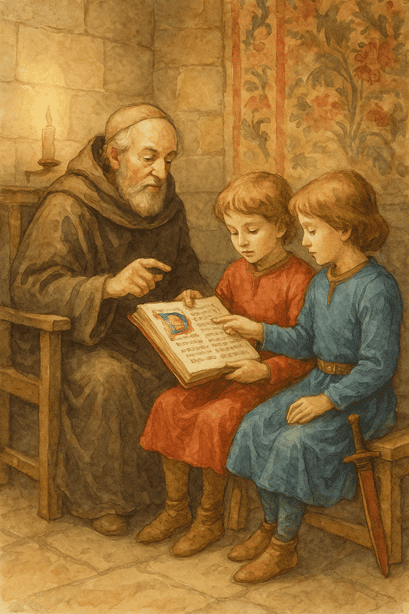
The education of noble boys was practical, religious, and martial, ensuring they grew into leaders, knights, or future lords. Lessons often took place under the eye of a cleric or chaplain, who was responsible for teaching them not just letters but also moral guidance.
- Reading and religion: Clerics taught basic literacy, often limited to Latin prayers and psalms. Religion was at the core of early education, shaping values and discipline.
- Courtly manners: Boys learned courtesy—how to bow, address superiors, serve at table, and show loyalty. These lessons were as important as reading and writing.
- Physical training: From wooden swords and mock combat to hunting and riding, boys were conditioned for war. Falconry and chess sharpened both body and mind.
- Moral instruction: The ideals of honor, loyalty, and Christian duty were instilled from a young age.
As they grew older, boys were often sent away from their parents to be fostered in another noble household. This practice built alliances between families while also ensuring boys learned discipline, service, and the arts of war from someone other than their father.
The Education of Young Ladies
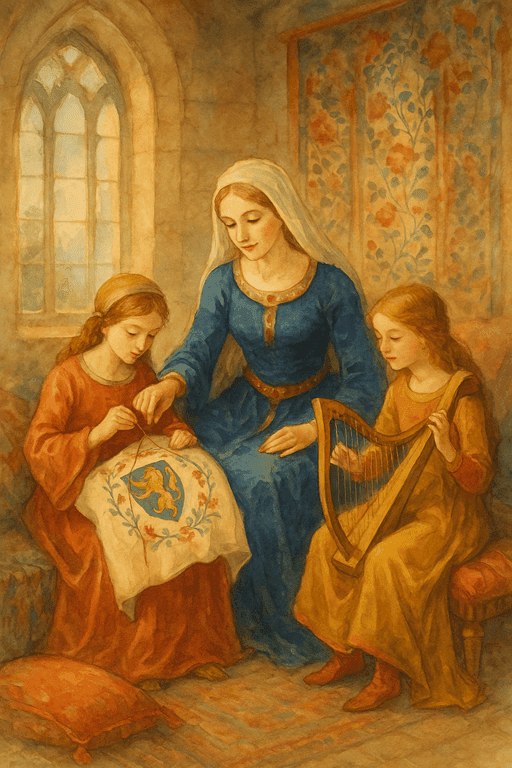
For noble girls, education was no less important, though it was oriented toward different roles. Girls were raised to manage households, secure alliances through marriage, and represent their families with grace and piety.
- Literacy and piety: Many noble girls were taught to read, often in French or Latin, so they could follow devotional texts and correspond with family.
- Domestic skills: Girls practiced embroidery, weaving, and spinning, not just as hobbies but as demonstrations of noble refinement. Textiles also carried political and cultural weight, adorning chapels and halls.
- Courtesy and conduct: Courtly manners were instilled early. Girls learned how to host guests, dance, play instruments, and maintain dignity in public.
- Music and culture: Many were taught to play instruments such as the harp or lute, to dance, and to recite poetry.
While the life of a girl may seem confined compared to her brother’s martial training, her education gave her authority within her future household and prepared her to be the cornerstone of family alliances.
Marriage could come shockingly early. While consummation was usually delayed, betrothals might be arranged in childhood, with girls promised to secure alliances.
Fosterage and Training for Knighthood
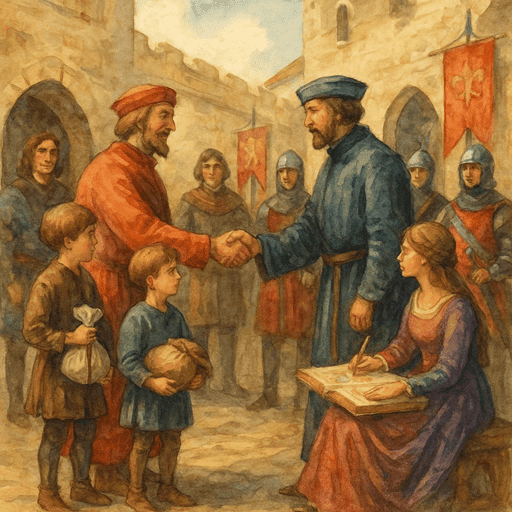
One of the most distinctive aspects of noble upbringing was fosterage. Around the age of seven, boys (and sometimes girls) were sent to another lord’s household. This was both a practical and political act—families cemented bonds through this exchange, while children gained valuable skills away from home.
- Boys: Became pages in another lord’s castle, serving at table, learning courtesy, and beginning physical training. Around age fourteen, they were promoted to squires, attending knights, caring for armor and horses, and practicing combat. Knighthood awaited only the most disciplined and courageous.
- Girls: When fostered, they learned the ways of another noble lady’s household, gaining instruction in running a large estate, observing courtly manners, expanding their marriage prospects and preparing for married life.
Fosterage built loyalty and resilience, ensuring children understood duty not only to their own family but to the wider network of noble society.
Play and Leisure: Childhood Amid Duty

Though their lives were structured and serious, children were still children. Play was considered an important part of development, often mimicking adult responsibilities.
- Boys: Played mock battles with wooden swords and shields, or practiced riding with hobby horses and small ponies.
- Girls: Enjoyed dolls, embroidery games, and simple indoor amusements with music and storytelling.
- Shared games: Both boys and girls might play ball games, dice, simple board games like nine men’s morris, tag, hide-and-seek, chase animals, or participate in falconry practice with family.
- Animals: Puppies, kittens, and small birds often became beloved companions. Hunting dogs and ponies provided both work and play.
These pastimes reinforced future roles: boys rehearsed knighthood, while girls rehearsed motherhood and household duties. Even their leisure was a preparation for adulthood.
Feasts and Family Life

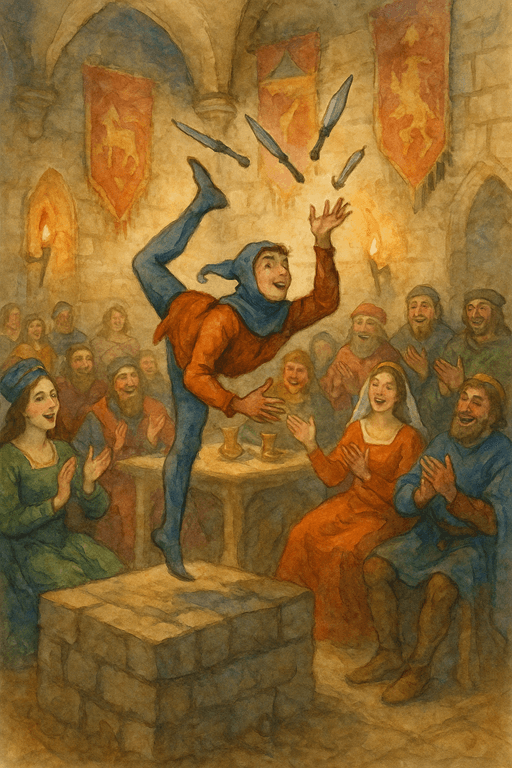
Children also participated in the grander aspects of noble life. They were present at feasts in the Great Hall, usually seated with their parents or tutors. These events were as much lessons as celebrations, teaching children how to behave at table, how to converse with guests, and how to understand their family’s place in the social order. Music, stories, and shared meals created memories but also reminded young nobles of the expectations they would carry into adulthood.
Discipline and Expectations
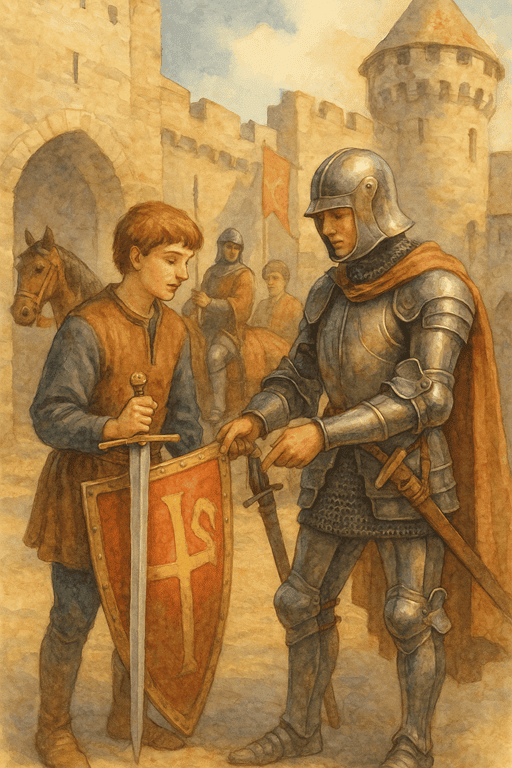
Childhood was brief in the Middle Ages. From an early age, noble children were expected to embody discipline, obedience, and honor.
- Strict discipline: Parents and tutors did not hesitate to enforce obedience, sometimes physically. A child’s behavior reflected directly on the family’s reputation.
- Early responsibility: Boys as young as seven might be given tasks in the hall, while girls learned to manage servants in the solar.
- Role models: Saints, biblical figures, and legendary heroes were held up as examples for noble children to imitate.
Failure was not an option—children were constantly reminded that their family’s survival depended on them.
Final Thoughts
Growing up in a medieval castle was both a privilege and a burden. Noble children lived surrounded by comfort, education, and servants, yet their lives were shaped by duty from the start. Sons were trained to become warriors and rulers, while daughters were prepared to manage estates and form alliances through marriage. Their childhood games and lessons prepared them not just for adulthood but for roles that carried the weight of family honor and dynastic survival.
While we may think of castles as cold stone fortresses, within their walls lived children who laughed, played, quarreled, and dreamed—just like children today. But unlike today, their futures were rarely their own. Their lives belonged to the destiny of their lineage, written long before they could even read.