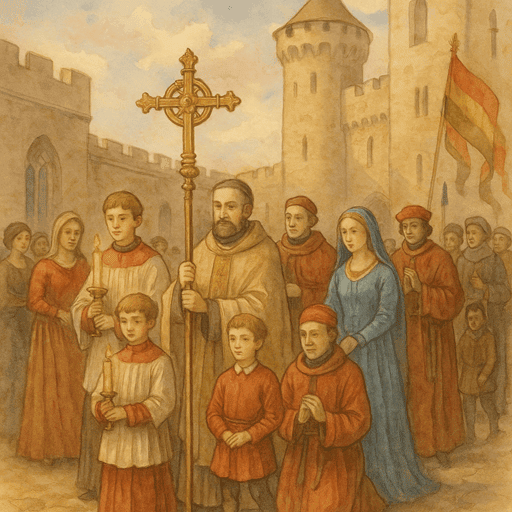
Healers, Midwives, and Herbalists in the Medieval Castle Community
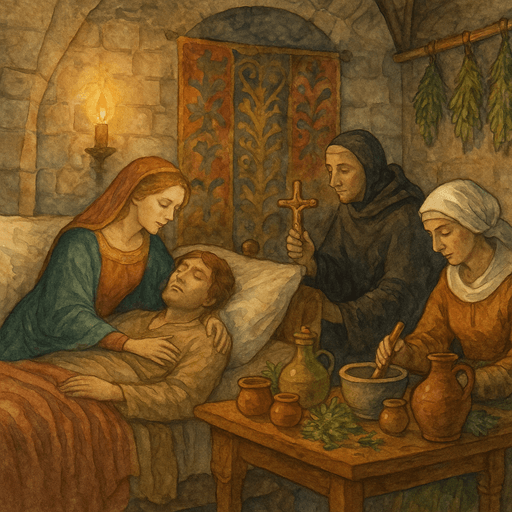
Though castles were built for defense and display, they were also homes—full of men, women, and children whose health needed constant care. Long before the rise of professional physicians and hospitals, the well-being of castle communities rested in the hands of healers, midwives, and herbalists. These figures blended practical knowledge, spiritual rituals, and folk traditions, providing remedies for everyday ailments, overseeing childbirth, and easing pain in an age when illness and injury were constant threats.
They were not always celebrated figures—some were trusted confidants, while others were eyed with suspicion, accused of witchcraft or malpractice if their treatments failed. Yet their presence was essential to the rhythm of life behind the castle walls.
Everyday Healers: Practical Care in a World of Danger
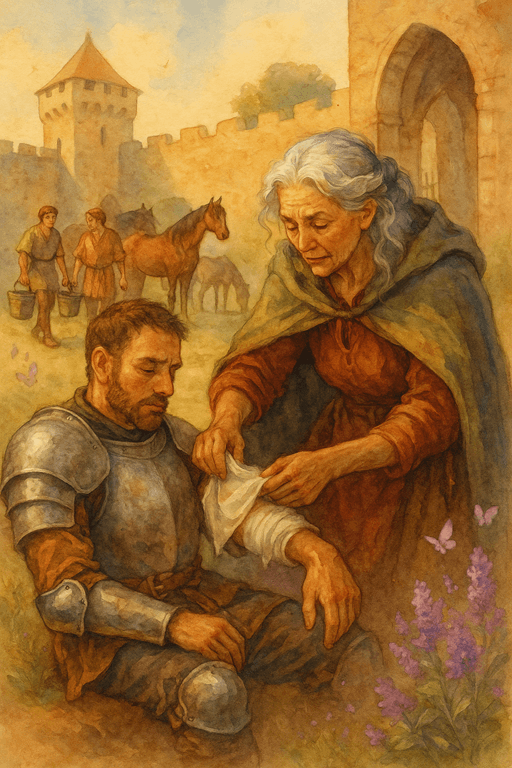
The daily life of a castle community was filled with physical hazards. Even within strong stone walls, people faced constant risks—burns from the smoky kitchens, cuts from carpentry tools, infections from dirty wounds, and injuries from handling restless horses. Soldiers and guards added to the burden, often returning from patrols, hunts, or skirmishes with bruises, sprains, or worse. In such an environment, the presence of everyday healers was not just convenient but essential. These were not university-trained physicians, but rather practical caretakers—sometimes older women, sometimes experienced men-at-arms—who had learned remedies through trial, error, and inherited knowledge. Their work bridged the gap between survival and despair, offering immediate care in a world where even a small wound could become deadly.
- Basic treatments: Cuts and bruises were washed with vinegar or wine, believed to cleanse wounds. Bandages were made from linen strips, sometimes coated in honey, which had natural antibacterial qualities.
- Bone-setting: Healers learned through experience how to reset broken bones or dislocated joints, often using wooden splints or tightly wrapped cloths.
- Pain relief: Willow bark, which contains a natural form of aspirin, was commonly used to dull pain. Warm compresses and herbal teas also played an important role in daily care.
While these remedies seem simple today, in a time with no antibiotics or advanced surgery, they often meant the difference between life and death.
Midwives: Guardians of Birth and Survival
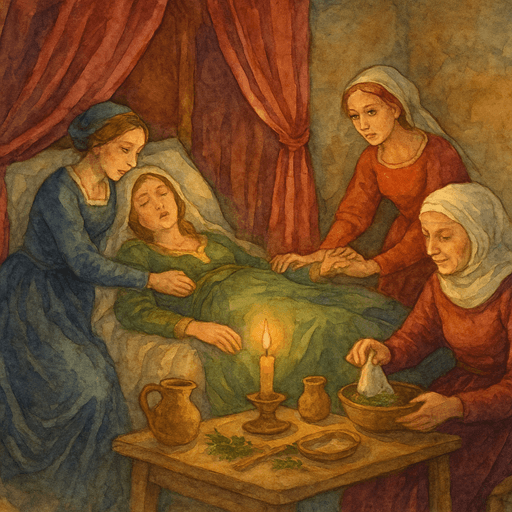
Among all the trials of medieval life, few carried more danger than childbirth. For noble ladies and servant women alike, labor was an ordeal shadowed by the very real possibility of death for mother, child, or both. Midwives stood at the center of this fragile moment, serving not only as practical attendants but as protectors of life and continuity. Their role extended far beyond delivering babies: they provided emotional support, guided women through hours of agony, and employed every tool at their disposal—herbal drinks to ease pain, whispered prayers for divine protection, and years of accumulated experience. In castle households, where the survival of heirs determined inheritance and lineage, the midwife’s presence was more than medical—it was political, social, and spiritual all at once.
- Role during labor: Midwives prepared birthing stools, comforted the mother with prayers and herbal infusions, and monitored the progress of labor. They assisted with cutting the umbilical cord and cleaning the infant.
- Spiritual and practical guidance: Midwives often called upon blessings and invoked saints for safe delivery, blending religious ritual with practical skill.
- Community trust: Their role gave them high standing within castle households and villages. They were respected but also vulnerable—if a birth ended in tragedy, they risked accusations of incompetence or even witchcraft.
Midwives were more than attendants; they were lifelines for families, ensuring continuity of noble and servant households alike.
Herbalists: Nature’s Pharmacy

In a world without apothecaries on every corner, nature itself was the medicine chest. Herbalists, often women but sometimes men, cultivated deep knowledge of plants, roots, and flowers, learning which combinations could ease pain, close wounds, or calm fevers. They were the keepers of a living library of remedies, much of it passed down orally or through simple hand-written collections. Castles frequently had herb gardens, sometimes tended by these herbalists, sometimes by monks, filled with lavender, sage, rosemary, comfrey, and dozens of other plants with practical and symbolic uses. Yet the herbalist’s role was never just about health—it was about survival. When illness swept through the servants’ quarters or when soldiers limped back from battle, their jars of tinctures and bundles of dried herbs became the first and sometimes only line of defense.
- Common remedies: Lavender to calm fevers, sage for digestion, comfrey to knit broken bones, and rosemary for cleansing wounds.
- Preservation of knowledge: Herbalists often learned from oral tradition, passing recipes through generations. Monastic gardens also preserved this knowledge, but castle herbalists made it immediately practical.
- Danger of suspicion: Because herbalists worked with mysterious plants and produced strong concoctions, they could be seen as dangerous. Their remedies might be praised when successful but feared as sorcery when they failed.
The herbalist’s chest of salves, dried herbs, and tinctures was as vital to the castle as swords and armor.
Physicians and Chaplains: Higher Medicine and Spiritual Healing
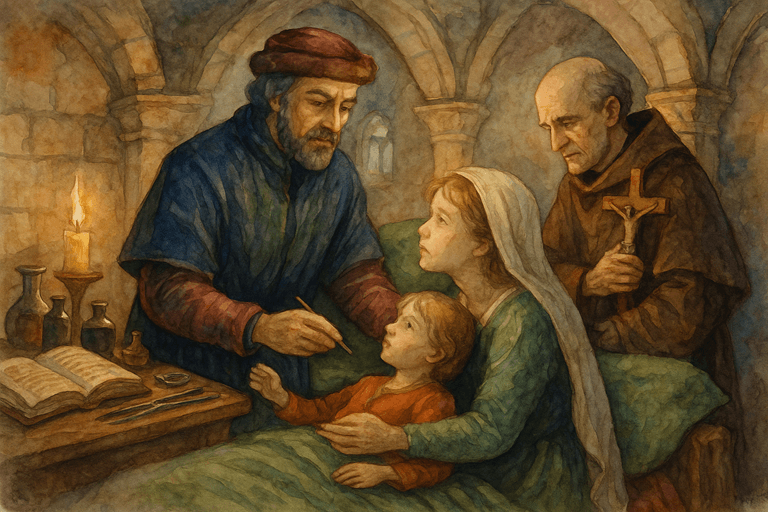
While everyday healers and herbalists tended most of the community, noble families sometimes sought out the rarer services of trained physicians. These men, usually educated in universities or influenced by Arabic medical texts, approached illness with scholarly methods rooted in the theory of the four humors. Their prescriptions of bloodletting, dietary regimens, or carefully measured medicines carried the weight of learning, even if not always of effectiveness. Alongside them stood the castle chaplains, who tended not the body but the soul. Illness was often seen as punishment or trial, and prayers, blessings, or confession were as vital as bandages or broths. Together, physicians and chaplains represented the more formal, authoritative side of healing—a reminder that medieval medicine was as much about faith and philosophy as it was about physical treatment.
- Physicians’ approach: They prescribed bloodletting, dietary adjustments, and carefully prepared medicines—though their effectiveness was mixed.
- Chaplains’ role: Healing was not purely physical. Illness was often seen as divine punishment or spiritual trial. Chaplains provided prayers, confessions, and blessings, reminding the sick that care for the soul mattered as much as care for the body.
The combination of practical, herbal, and spiritual healing shows how medieval medicine blurred the boundaries between body and spirit.
Risks of the Trade: Suspicion and Witchcraft
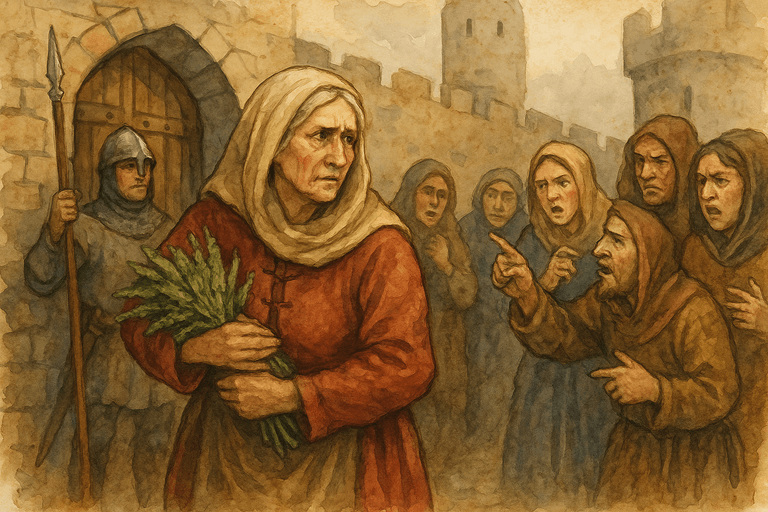
Despite their importance, healers, midwives, and herbalists lived under a cloud of uncertainty. Their successes brought gratitude, but their failures could quickly lead to fear or accusation. In an age where illness could strike unpredictably and death was never far away, desperation often turned to suspicion. A midwife whose patient died in childbirth might be accused of incompetence—or worse, of witchcraft. An herbalist whose potions failed to cure could be branded dangerous, her craft seen as sorcery rather than healing. Even everyday healers risked punishment if their treatments displeased a lord or lady. This precarious balance meant that those who dedicated their lives to caring for others also lived under constant threat, their work celebrated in times of success but perilous when outcomes turned grim.
- Accusations: A failed cure or tragic death could bring suspicion. Midwives, in particular, were sometimes accused of witchcraft if infants died during birth.
- Regulation: By the late Middle Ages, guilds and church authorities began trying to regulate healers, favoring male physicians trained in universities over local women who practiced traditional medicine.
- Legacy: Despite this, many continued their work in secret or under the protection of noble households, whose survival often depended on their skills.
The precarious position of healers reflects the fragile balance between respect and fear that defined much of medieval life.
Final Thoughts
Healers, midwives, and herbalists were the quiet backbone of castle communities. They stitched wounds, eased childbirth, calmed fevers, and offered both comfort and cure in a world without modern medicine. Though their remedies sometimes failed, their work was essential in preserving life within the walls of medieval castles.
Their presence reminds us that castles were not only centers of war and politics, but also of fragile humanity—where the cry of a newborn, the pain of a servant’s injury, or the whispered prayer of a chaplain revealed the vulnerability beneath the stone walls.